
Ethics, Energy, and Efficacious Behavior: Reclaiming Personal Agency in Modern Real Estate
Author: Rossi
Target Audience: Real Estate Brokers, Team Leaders, and Sales Associates
Executive Summary
Today’s real estate professional faces an environment defined by rapid market shifts, heightened regulatory scrutiny, algorithmic competition, and fragmented client trust. When market pressure escalates, the industry frequently defaults to reactive compliance—viewing ethics merely as a defensive mechanism against liability.
This paper presents a radically different paradigm: Ethics, Morals, and Pragmatism are not static constraints; they are the core engine of personal agency and professional efficacy.
By understanding how internal sensory programming drives external behavior, real estate professionals can move beyond passive risk management to cultivate high trust, sustainable success, and unwavering self-mastery.
I. The Modern Landscape: Why Ethics Beyond the Code Matters Now
In a hyper-connected market, professional standards cannot be reduced to a legal checklist. Consumers demand authentic direction, strong values, and decisive execution.
- Beyond Minimum Compliance
- The REALTOR® Code of Ethics sets the baseline, but personal commitment defines the ceiling.
- What an industry tolerates becomes its culture; accepting mediocrity or minor dishonesty erodes public trust for all.
- Self-Policing and Collective Integrity
-
- Avoidance is complicity: Turning a blind eye to unethical or incompetent behavior within the industry compromises the collective brand of real estate professionals.
- Proactive participation in mediation, professional standards, and local board ethics committees is essential for safeguarding the profession.
- The Rule of Interpersonal Reality
-
- If an individual lies, cheats, or manipulates on your behalf today, they will inevitably turn those same tactics against you tomorrow. Alignment with high-integrity partners, clients, and brokerage environments is a non-negotiable business strategy.
II. The Triad of Action: Ethics, Morals, and Pragmatism
To control outcomes, an agent must first understand the three distinct forces governing every decision made under pressure.
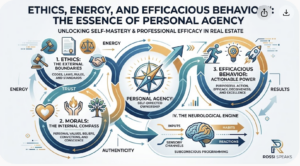
1. Ethics (The External Guardrails)
- Definition: Standards established by laws, administrative codes, and governing bodies.
- Function: Provides external order and establishes systemic minimums.
2. Morals (The Internal Compass)
- Definition: Faith-based principles, personal convictions, and core values.
- Function: Drives internal motivation and shapes long-term goals.
- Value Prioritization: Behavior is propelled by values that remain unfulfilled. When core values (e.g., integrity, service, stability) are consciously aligned, they govern automated decision-making under stress.
3. Pragmatism (The Danger Zone of Ego and Justification)
- Definition: A practical approach where truth is judged solely by immediate outcomes rather than absolute principles.
- The Ego Trap: When ego dominates, reframing and rationalization follow (“Everyone does it,” or “That depends on what the meaning of ‘is’ is”). The higher the ego, the stronger the justification for cutting ethical corners.
III. The Neurological Engine: How Subconscious Programming Drives Behavior
Ethical choices are rarely made through cold, slow logic in the heat of a deal. They are driven by subconscious programming built over time.
-
The Role of the Subconscious Mind
- The subconscious functions as an uncritical executor; it carries out whatever commands the conscious mind consistently reinforces.
- It does not distinguish between an actual event and a vividly imagined scenario.
- Sensory Anchoring and Habit Formation
-
- Mental programming occurs through the five senses. The more sensory channels involved in an experience or visualization, the deeper the neural pathway.
- Agents who constantly visualize worst-case scenarios, conflict avoidance, or shortcut solutions condition themselves to act reactively under pressure.
-
Perceptual Filters
-
- Decision-making is filtered through intuition, early parental influences, formal education, and past experiential conditioning. Recognizing these filters prevents reactive, ego-driven mistakes.
IV. Efficacious Behavior: Agency in Action
Efficacy is not mere busyness or hustle; it is the direct capacity to produce a intended, high-value result through purposeful action.
-
Defining Modern Efficacy
- Doing the fundamental basics better, more consistently, and with higher standards than anyone else in the marketplace.
- Operating from a firm commitment to mutual benefit (Win/Win or No Deal).
-
Truth as an Operational Strategy
-
- Disclosure as a Pledge of Truth: Withholding vital information out of fear—fear of disturbing a deal, angering a client, or creating conflict—is functionally equivalent to deception.
- Under-Promise and Over-Deliver: Distortion and exaggeration undermine long-term credibility and frequently cross into legal misrepresentation, which standard Errors & Omissions insurance does not protect against.
- Radical Ownership: Owning mistakes immediately restores trust faster than attempting to cover up missteps.
-
From Prospecting to Lead Generation Efficacy
-
- Shift from Ego Marketing (self-aggrandizing claims and high-pressure tactics) to Matter-of-Fact Value(clear, transparent, and client-centered direction).
- Frame every action through the client’s perspective: What’s In It For Them (WIIFM).
V. Conclusion: Stepping Firmly into Today’s Market
A high-performing real estate career is not built by reacting to market fluctuations or adopting every short-term shortcut. It is built on the rock-solid foundation of personal agency: Ethics for external clarity, Morals for internal alignment, and Efficacy for disciplined execution.
When agents step into the market backed by strong values, deep preparation, and absolute truth, they do not need to step on toes to win—they become the benchmark against which all others are measured.