
What Science Taught Me About Past Pain and Future Decisions
For fifty-five years in real estate, I thought I had every logical tool imaginable in my quiver.
I’ve walked buyers through market crashes, economic freezes, and shifting financial tides. I know the math. I know the spreadsheets. I know how to lay out numbers so clearly that any rational human being can see the path forward.
And yet, just recently, I watched a 33-year-old homebuyer walk away from a $299,000 purchase—and forfeit his $2,000 due diligence check—over a shift in interest rates from 5.25% to 6.45%.
On paper, the math difference was about $183 a month. Six bucks a day. I pulled out every piece of logic I possessed. I showed him the security of a 30-year fixed loan. I showed him how we could negotiate. I showed him that his payment would never balloon.
He looked at me, shook his head, and said:
“No! This happened to my parents back in the early 2000s. They got caught in an adjustable payment rate that jumped so high it stretched our budget to the breaking point. They fought constantly. Dad worked long overtime hours, Mom was crying all the time. Us kids were afraid to ask for lunch money, let alone an allowance. Mom took a job and we hardly saw her. They finally divorced, we changed schools, I lost all my friends, and my life sucked. I am not going to do that to my children.”
In that single second, fifty-five years of logical real estate expertise melted away against the immovable wall of human emotion.
I realized right then and there: I wasn’t arguing with a calculation. I was arguing with a memory.
He wasn’t looking at a spreadsheet; he was looking through the eyes of a frightened ten-year-old kid sitting at a kitchen table twenty years ago. Past pain was actively directing his future. His nervous system didn’t care about a $183 monthly difference—it was screaming at him to protect his five-year-old and nine-year-old from a ghost.
That moment humbled me. It sent me searching for answers, trying to understand why logic fails so completely when old memories get triggered.
What the Scientists Discovered
As I dug into the research, I stumbled across a fascinating landmark study published in Nature by neuroscientists at Mount Sinai. They were asking the exact same question I was: Why does past adversity cause the brain to overreact to future stress?
Rather than just looking at the usual threat centers like the amygdala, these researchers mapped the entire brain to see how past pain hardwires our reactions.
What they found was an overlooked region deep in the subcortical core called the Anterior Hypothalamic Nucleus (AHN).
Reading through their findings, the best way I can interpret what the neuroscientists uncovered is to think of this structure as the volume knob in the mind.
Here is how the researchers explain what happens inside the biology:
- The Brain Tracks Cumulative Weight: When we go through prior adversity, this deep structure logs that negative emotional weight and hyper-sensitizes the brain’s threat network.
- It Amplifies the Next Signal: When a new, even minor stressor appears, this hyper-sensitive node dials the physiological volume all the way up. The signal passing from the brain’s alarm system isn’t just received—it’s amplified.
- The Rewired Circuit: In a person with a history of stress, the communication pathway between the alarm system (amygdala) and this volume knob (AHN) becomes hyper-synchronized. The brain turns up the gain on stress before executive logic or reason ever gets a chance to speak.
Most remarkably, when the scientists temporarily silenced this specific neural pathway in the lab, the amplifying effect of past trauma completely vanished. The past lost its power to hijack the present moment.
Interpreting the “How”: Turning Down the Volume
Finding that research was an eye-opener for me. It made me realize that telling someone—or telling ourselves—“don’t let past trauma rule your decisions” is like telling a drowning person to just breathe the air. When that deep-brain volume knob gets cranked, logic cannot enter through the front door.
So how do we translate what neuroscientists know into how we actually live, work, and talk to one another?
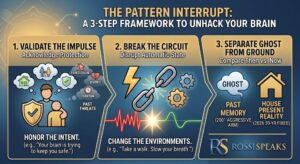
As I see it, we have to use a step-by-step approach that addresses the nervous system first, the narrative second, and the numbers last.
Step 1: Validate the Impulse
The researchers showed that the brain is running an automatic protection program. If we argue with that program, the brain registers us as part of the threat, and the volume goes higher.
Instead of fighting the reaction, we have to honor the protective intent behind it. My buyer wasn’t being irrational; he was being a protective father to his two young kids.
- What NOT to say: “You’re making a mistake, the math doesn’t work like that.”
- What TO say: “I hear you. And honestly? I respect the hell out of why you’re saying no right now. You are standing up as a husband and a father to make sure your family never goes through what you lived as a kid. That makes you a great dad. Period.”
The second a person feels truly heard, the alarm system relaxes its grip. You’ve put a hand on the volume knob.
Step 2: Interrupt the Pattern
When that threat network hyper-synchronizes, it locks down perspective. Before we can talk business, we have to interrupt the physical loop.
- Change the Environment: Step away from the desk. Take a short walk outside or grab a cup of coffee.
- Change the Speed: Lower your vocal pitch and slow your speaking tempo. Calibrating your tone gives their nervous system an anchor to match.
- Ask a State-Shifting Question: Ask a question that gently coaxes the brain out of threat-processing and into reflection: “If your dad were sitting right here beside us today, knowing what he knows now about how those old adjustable loans worked, what advice do you think he’d give you?”
Step 3: Separate the Ghost from the Ground
Now—and only now—can logic re-enter the conversation. Our job as interpreters and guides is simply to help lay out the difference between the ghost (the memory from twenty years ago) and the ground (the reality of today).
We lay out the distinction side-by-side:
| The Ghost (2000s Memory) | The Ground (Today’s Reality) |
| Adjustable-Rate Loan—payments jumped wildly when rates reset | 30-Year Fixed Loan—principal and interest can neverincrease |
| Unpredictable market resets trapped parents with no ceiling | Total control—fixed maximum payment with the option to refinance later |
| Total household budget collapse | A $183/month difference ($6 a day) |
When we frame it this way, we aren’t arguing with their past; we are just helping them see that the monster they are hiding from isn’t in this room.
Adjusting Our Own Dial
I don’t claim to have all the biological answers—I’m just a guy who spent fifty-five years listening to people make big decisions, looking for tools to help them make better ones.
The next time you catch yourself or someone you care about reacting with unusual intensity to a sudden setback, a market shift, or an unexpected conflict, pause and ask one simple question:
“Is this reaction proportional to what is happening right now—or is the volume knob stuck on a channel from the past?”
Once we see that the noise is coming from an old recording, we gain the power to reach down, adjust the dial, and step safely into the future.