
For 54 years, I’ve been a proud member of the National Association of Realtors (NAR). My enduring loyalty stems from the organization’s unwavering commitment to a published Realtor Code of Ethics, a document that has governed us since 1909. As an ethics instructor for this code, I’ve seen firsthand how it upholds the integrity of our 1.5 million members—making us the largest trade organization in the world. For us, ethics aren’t a luxury; they’re a necessity.
Over 114 years, our code has been continually refined, but one principle has always stood firm: members never disparage fellow Realtors. You’ll never hear a Realtor say, “Don’t call Realtor A, they’re liars!” or “Realtor B is cheating their clients!” We simply don’t behave like politicians.
This brings me to a critical question: where are our political ethics? They seem to be nonexistent. Our elected officials campaign not on their proposed actions, but on tearing down their opponents. They focus on what their adversaries haven’t done, what they’ve done wrong, and a litany of other negatives.
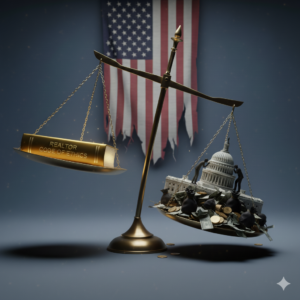
Once elected, they immediately begin soliciting funds for their next campaign, leaving us to wonder who’s truly running Washington. The answer is clear. With more than 200 lobbyists for every elected official, it’s not the people we voted for—it’s the money.
I confess, I’ve been caught in this political morass, consumed by the deceit and division. But I’ve come to realize that this isn’t a new phenomenon. The absence of a strong ethical foundation in our political discourse has been weakening America’s public trust for generations. It has brought us to a point where voters are forced to make a difficult choice:
- Vote for the candidate whose lies you find more palatable.
- Or, vote for the candidate you believe is not lying.
Now, the influence of money has grown to the point of silencing news outlets, making it even harder to discern the truth. In a system where financial power dictates the narrative, America is no longer truly free. It has been sold to the highest bidder, and the value of your vote diminishes with every new transaction.